Limited Time Discount! Shop NOW!
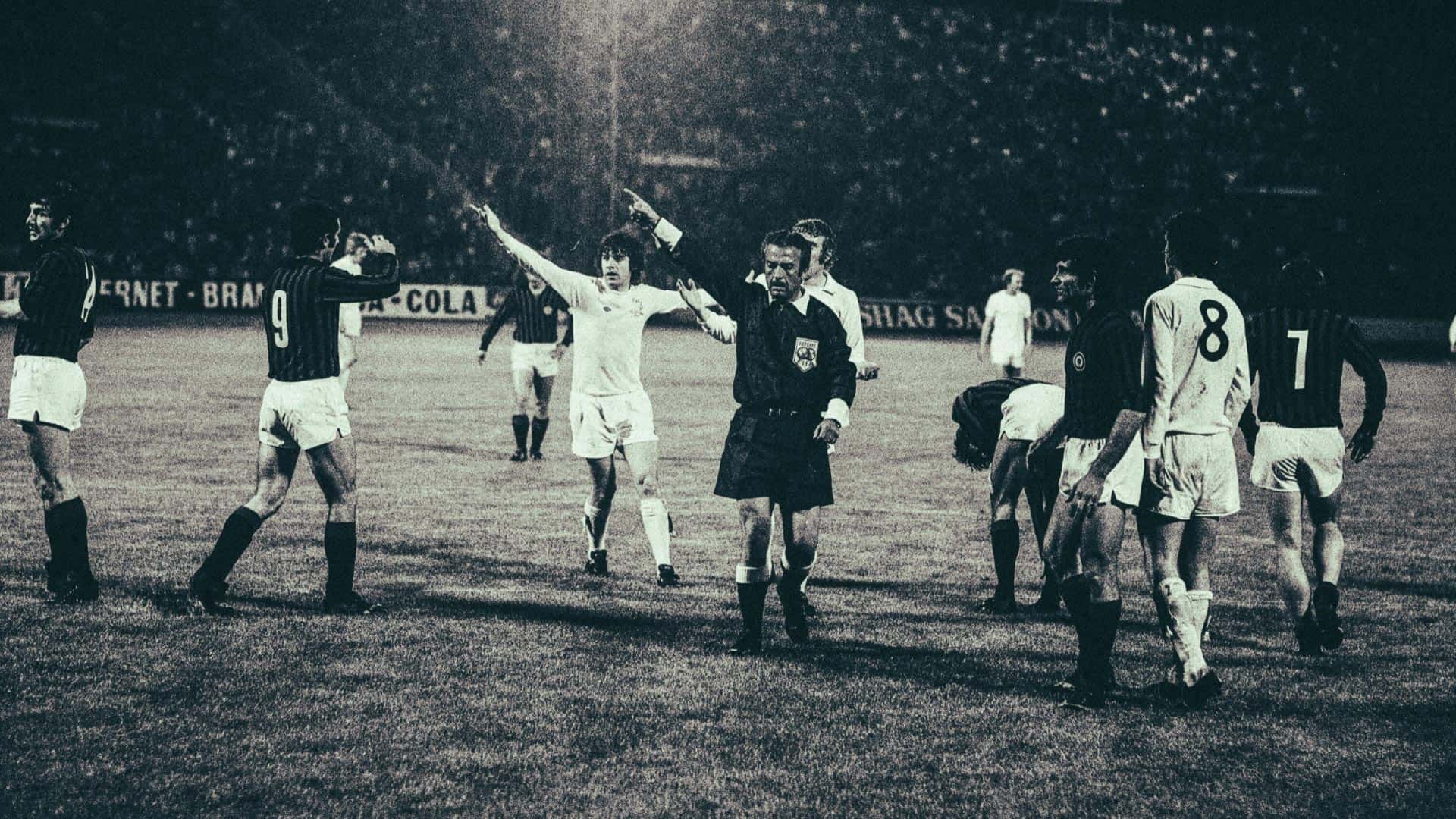
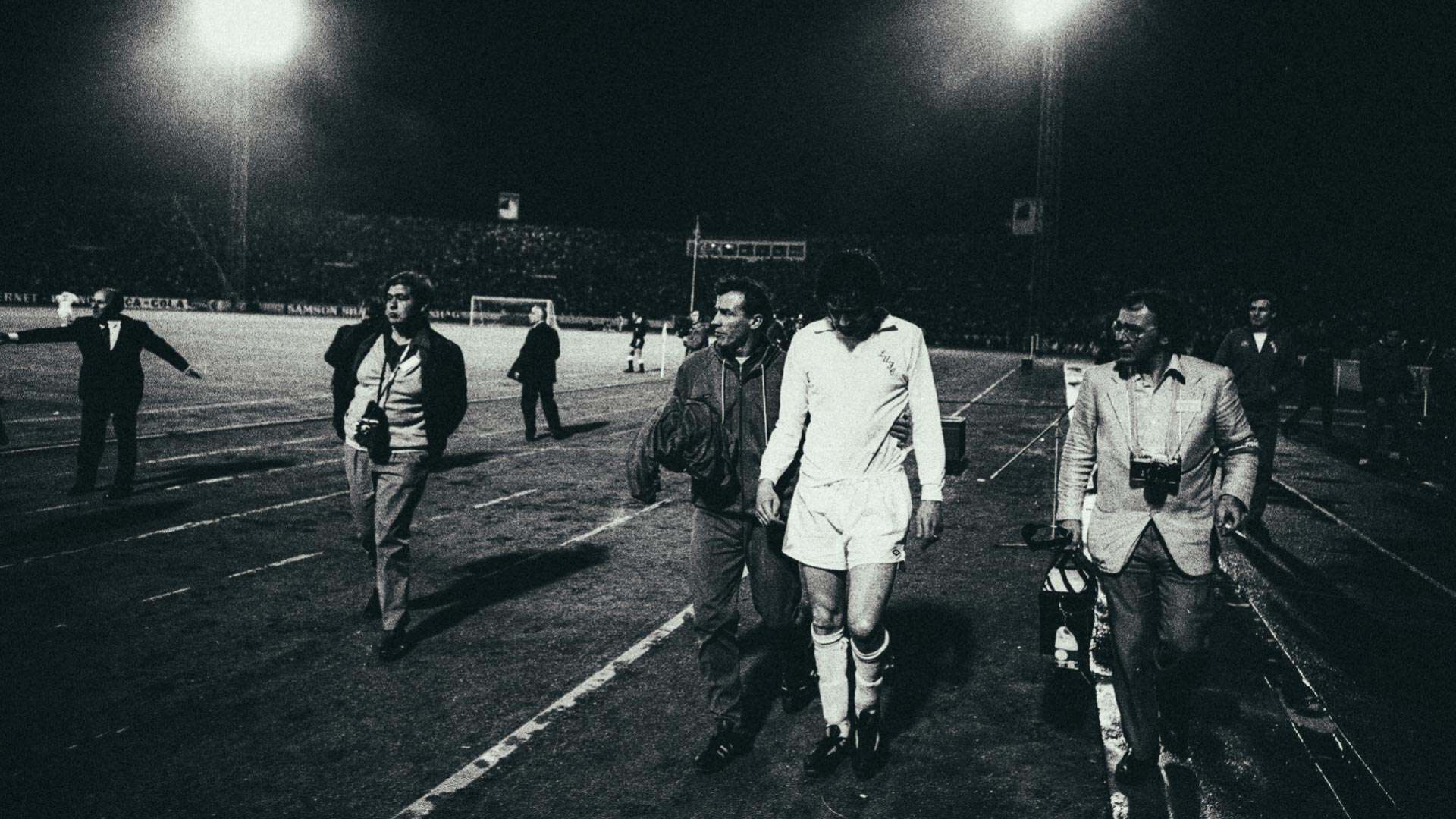
“Someone up there doesn’t like us, I don’t know what we’ve done,” Don Revie told a gaggle of journalists huddled around him in Salonika. The Greek city that once boasted the title of co-capital of the Byzantine Empire had been reduced to a joke after Christos Michas’ refereeing performance in Leeds United’s 1-0 ‘defeat’ at the hands of AC Milan in the 1973 Cup Winners’ Cup final.
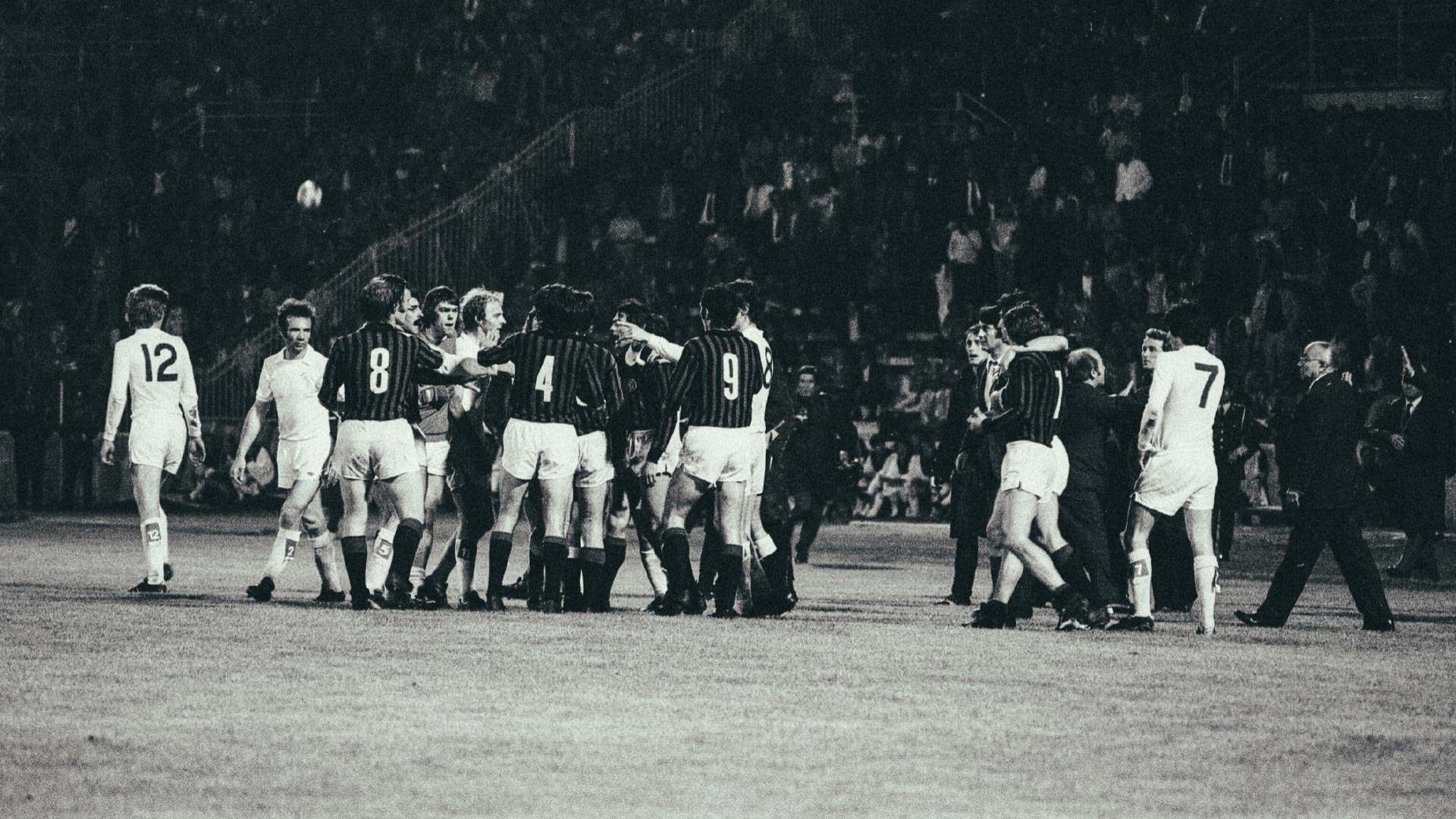
The locals in attendance booed Milan and the referee but cheered the valiant United side off the pitch after ninety minutes that had shamed football. Michas denied three reasonable penalty claims from United and allowed Milan players to kick lumps out of their opponents without consequence. The referee made himself even more unpopular when Norman Hunter decided he’d had enough of Riccardo Sogliano kicking him and punched him in retaliation as the game got away from Leeds, only for Michas to send them both off.
“The word is we can’t win this game,” said Johnny Giles to teammates before the game, indicating that he’d heard something indicating that the game was fixed.
This is where Dezso Solti comes into the story — we think. Back in 1973, football wasn’t the multi-billion pound industry and global cultural phenomenon we know today back, but money had started to flow. Solti, at this stage, was a shadowy figure coming to the end of a decade ‘influencing’ refereeing decisions at the top of European football, yet the general public had no clue about this mysterious fixer.
With the passing of time it has become clear that perhaps the people working with Solti didn’t know much about him either. Born in Hungary in 1912, he spent the first thirty years of his life doing a bit of everything, just enough to get by. Nazi Germany’s invasion of Hungary meant Solti, whose real name was Dezso Steinberger, soon found himself taken to Auschwitz with his family, who were killed immediately.
Solti was spared and used for labour, quickly gaining favour with the Nazis by touting on fellow prisoners, becoming a camp Kapo, a kind of lead collaborator. He became an ‘assistant’ to Josef Mengele, the Nazi doctor who performed horrendous experiments on Jewish prisoners.
He returned to Hungary after the war and worked with the government to bring down the opposition leader in a scandal, for which they allowed him to leave the country and move to Italy. Solti had an entertainer’s licence, claiming to be a magician with six ‘essential’ female dancers brought along with him. In reality, he was a pimp and those women were trafficked to powerful figures in the country.
Solti met Milan coach and compatriot Béla Guttmann while living in the city during the mid-1950s, and somewhere in there his flirtation with football began. Solti had made a fortune selling stolen art and various other goods of questionable origin, all the while operating with Hungarian, Italian and Argentine passports.
Italian club football found itself at the pinnacle of the European game in the early 1960s, both Milan and Inter reinventing the sport with ‘catenaccio’, a defensive style that became synonymous with the nation. Solti told friends that he was working with Inter as an intermediary at this point, tasked with bribing referees, even claiming to be a personal friend of club president Angelo Moratti.
Borussia Dortmund received a questionable red card in their 1963/64 European Cup semi-final loss to Inter, who went on to win their first title. A year later, Liverpool’s Tommy Smith was so infuriated with referee Ortiz de Mendibil’s favouritism towards Inter that their semi-final ended with the defender booting De Mendibil in the tunnel, frustrated with another Inter win.
As the Italian club chased a third consecutive title, Solti allegedly attempted to bribe Hungarian referee — and friend — Gyorgy Vadas to ensure Inter beat Real Madrid in the 1965/66 final. Vadas’ conscience got the better of him and Inter lost, but the referee never officiated a European game again on the orders of Solti.
By the time Leeds came across Solti — again, allegedly — he had ‘moved’ to Juventus with Italo Allodi, who had worked as Inter’s general manager during the 1960s. Brian Clough and Derby County faced Juve in the European Cup semi-final the month before Leeds’ Cup Winners’ Cup final.
Fernando Marques Lobo was tasked with refereeing the second leg in Derby and was approached by Solti before the game with a gold watch and $5,000 cash to guarantee Juventus progressed, having already won 3-1 in Turin in a game that Clough insisted was fixed. Lobo reported everything to UEFA and was deemed to have refereed the game fairly, but the Derby manager still asked The Times journalist and Italian speaker Brian Glanville to translate “cheating bastards” for the assembled Italian reporters.
Solti worked for Juve at the time, but the former pimp worked for whoever paid him enough and had no qualms about betraying perceived loyalties. Glanville did more than translate Clough’s ranting, it was he and colleague Keith Botsford’s expose in The Sunday Times a year after the Derby debacle that brought to light more than a decade’s worth of corruption centred around Solti.
They went as far as to claim that Solti was working as a double agent with Real Madrid in 1966, when his mate Vadas ‘refused’ the bribe. Glanville actually spoke to Vadas, who told him that Solti offered him enough money “to buy five Mercedes cars” if he let Inter win that night. Solti told friends that Vadas had taken $60,000 from him but failed to come through for Inter. He declined to mention if the money was ever returned, in his version of events.
Glanville’s story prompted a feeble UEFA investigation, in which Juventus chairman Giampiero Boniperti denied the allegations that they attempted to bribe Lobo. “If there are crazy people out there offering a referee $5,000 out of their own pockets to help Juventus win, it’s not our fault,” said Boniperti. UEFA believed him and banned Solti for a year. Leeds United presented a similar case, alleging bribery from Milan to referee Michas, but to no avail.
Solti disappeared from view around this time, though some reports indicate this was due to Hungarian secret police finding dozens of valuable paintings — including multiple originals Picassos — in the attic of his suite at Budapest’s Hotel Royal.
It seems that Solti never worked in football again after 1973, his reputation left in tatters by Glanville exposing him. Whether or not he actually bribed Michas on Milan’s behalf, or whether the referee was bribed at all has never been definitely proven, but it doesn’t take Pablo Picasso to paint a picture in which this was reality.
The surreal life of Dezso Solti feels more like a Hollywood film, even without the bribery and Brian Clough. One should reserve the tiniest violin for Inter and Juventus’ players, who throughout those years were excellent in their own right and may well have won those trophies without the interference of the ‘independent’ fixer Solti.
The Milan team that lifted the Cup Winners’ Cup in 1973 was a great team also. Leeds went to Greece without the suspended Billy Bremner and Allan Clarke, while Giles sat in the stands injured. Don Revie had reportedly accepted the Everton job the night before the game and Leeds were less than two weeks removed from losing the FA Cup final in ignominious circumstances to Second Division Sunderland.
Solti lived out his final years in Milan, never again working in football. He lived alone but met up with a jeweller friend for lunch each day. Documentarian Béla Szobolits spent a day with Solti in 1990 hoping to find out about the mind boggling life he had lived. “Football is a game of fine margins,” he told Szobolits. “All we did was try to ensure those were not against Inter.” Or Juventus, or Milan, maybe. It’s a small consolation knowing that United’s claims weren’t those of bitter losers, but perhaps justified by years of evidence ignored by those in power. ⬢
This article is free to read from issue seven of The Square Ball magazine. Get your copy here.
£3.00

£12.00
£16.00